Get Your
ISO Registration 2026
Start ISO Registration 2026
Fill in the form and complete process to receive your certificate.
Note: We are India’s fastest growing online business services platform dedicated to helping people to start and grow their business, at an affordable cost. Our aim is to help the entrepreneur with regulatory requirements, and offering support at every stage to ensure the business remains compliant and continually growing. We are Private Organization and providing services and assistance for Business Benefits who require consultation.
What is ISO Registration?
ISO registration is the process through which an organization obtains certification from the International Organization for Standardization (ISO), a globally recognized independent body that develops and publishes standards to ensure the quality, safety, and efficiency of products, services, and systems.
Primary Objective of ISO Registration
The primary objective of ISO registration is to validate that an organization adheres to internationally established standards, demonstrating commitment to maintaining high-quality processes and outcomes.
Why ISO Certification Matters
Enhances Trust & Credibility: Certification improves trust among customers, partners, and stakeholders, helping businesses establish a competitive edge in their industries.
Demonstrates Commitment: Shows your organization's dedication to quality, safety, and continuous improvement across all operations.
Aligns with Specific Goals: Different ISO standards like ISO 9001 (quality management) and ISO 14001 (environmental management) enable businesses to align with their strategic objectives.
Key Benefits for Your Business

Popular ISO Standards
Ready to Get ISO Certified?
Let our experts guide you through the certification process with 100% online support.
Start Your ApplicationTypes of ISO Certifications
We provide expert assistance with various ISO certifications tailored to your industry needs, ensuring compliance with international standards and continuous improvement.
ISO 9001
Quality Management Systems
Guarantees quality consistency in products and services, with the goal of customer satisfaction and continuous improvement.
ISO 14001
Environmental Management Systems
Assists organizations in reducing their environmental impact and meeting environmental laws.
ISO 45001
Occupational Health and Safety
Emphasizes enhancing workplace safety and minimizing risks to employees.
ISO 27001
Information Security Management
Protects sensitive data and establishes robust information security practices.
ISO 22000
Food Safety Management
Created for the food industry to provide safe and high-quality food manufacturing and handling.
Looking for Other ISO Standards?
We provide consultation and certification assistance for all ISO standards including ISO 13485 (Medical Devices), ISO 50001 (Energy Management), and many more specialized standards tailored to your industry.
Eligibility Criteria for ISO Registration
ISO certification is not industry-specific, making it accessible to a wide range of organizations across all sectors and sizes.

Types of Organizations Eligible
Note: ISO standards can be tailored to your organisation’s size and sector to deliver measurable improvements.
Requirements for ISO Certification
Need help getting your ISO Certification quickly?
Documents Required for ISO Registration
To apply for ISO Certification, your organization must provide certain documents that demonstrate compliance with the chosen ISO standard and ensure a seamless application process. Below is a list of essential documents with brief explanations:
1. Business Registration Certificate
Proof of your organization's legal registration, establishing its legitimacy.
2. Organizational Structure Document
A detailed chart or description outlining your company's hierarchy, departments, and roles to give auditors an understanding of how your organization operates.
3. Process Flowcharts
A clear visual representation of your operational workflows, showcasing how processes are managed to ensure quality and efficiency.
4. Quality Policy and Objectives
A formal statement of your organization's commitment to maintaining high standards of quality and achieving measurable goals.
5. Management Review Records
Documentation of management meetings focused on evaluating processes, identifying risks, and implementing improvements to maintain compliance with ISO standards.
6. Internal Audit Reports
Records of internal audits conducted to assess your organization's adherence to ISO requirements and readiness for external certification audits.
7. Proof of Compliance with Legal and Regulatory Standards
Evidence that your organization complies with applicable laws, regulations, and industry-specific standards.
Note: Additional documents may be required depending on your chosen ISO standard and industry-specific regulations. Our experts will guide you through the complete documentation process.
Application Process
Step-by-step guide to obtaining ISO Certification for your organization.
Identify the Relevant ISO Standard
Determine the ISO standard that aligns with your business goals (e.g., ISO 9001 for quality management, ISO 14001 for environmental management).
Gap Analysis and Preparation
Conduct a gap analysis to compare your current processes with the requirements of the chosen ISO standard. Identify areas for improvement and implement necessary changes.
Document Management System
Compile all required documents, including process flowcharts, quality policies, and internal audit reports, ensuring they meet ISO standards.
Select an Accredited Certification Body
Choose a trusted certification body to conduct the ISO audit. Ensure they are accredited and recognized in your industry.
Application Submission
Submit your application and required documents to the certification body for review.
Preliminary Audit (Optional)
Some organizations opt for a preliminary or Stage 1 audit to identify areas of non-compliance before the final certification audit.
Certification Audit
The certification body conducts a comprehensive audit of your processes and documentation to ensure compliance with ISO standards.
Receive Certification
Upon successful completion of the audit, your organization will be awarded ISO Certification, valid for a specified period (usually three years).
Audit & Certification Process
The audit process validates your organisation’s adherence to ISO standards for quality, safety, risk management, and continual improvement.
Stages of the Certification Audit
Stage 1: Documentation Review
The auditors examine your documents, such as process flowcharts and quality policies, to ensure they align with ISO standards.
Stage 2: On-Site Audit
Auditors visit your premises to assess the practical implementation of your processes and policies. They'll also interact with your team to verify awareness and adherence.
Stage 3: Audit Reporting
After the audit, you'll receive a detailed report identifying compliance areas and any gaps that require corrective actions.

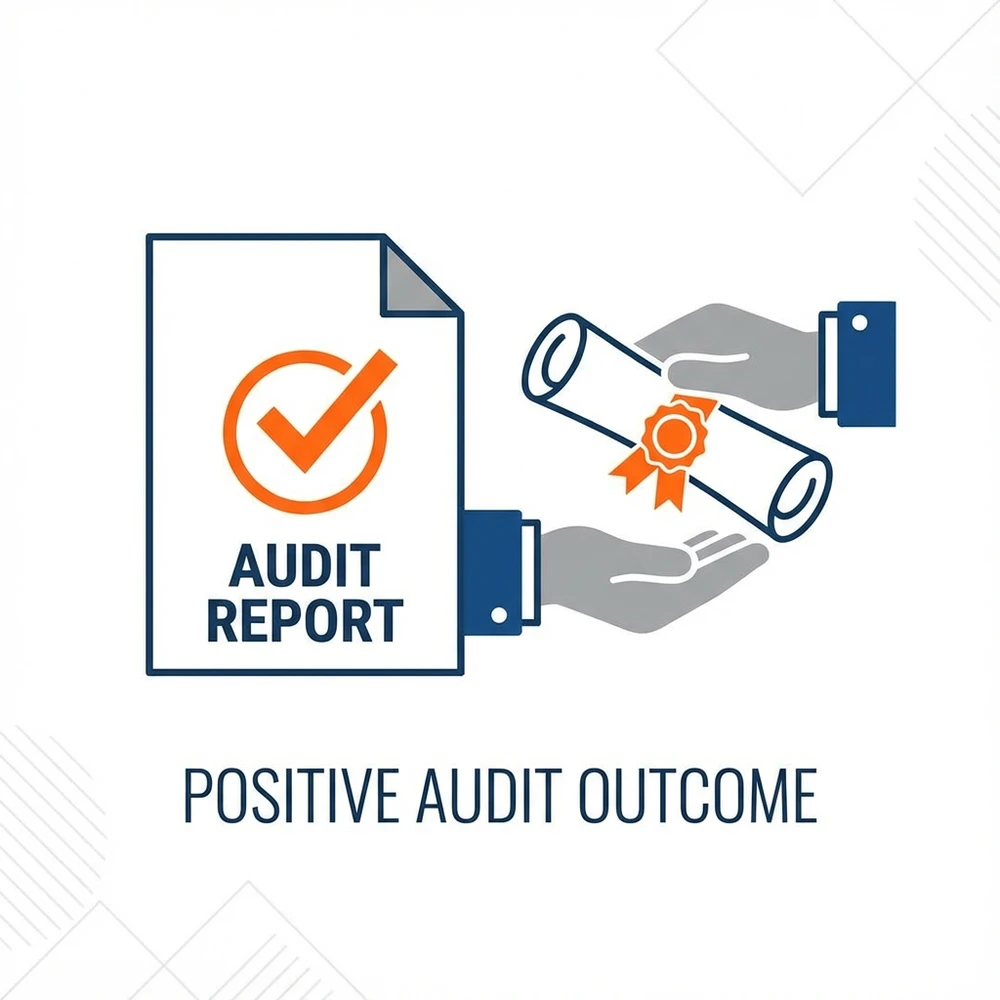
Possible Outcomes of the Audit
Certification Granted:
Congratulations! You'll receive your ISO Certification if all requirements are met.
Non-Conformities Identified:
Minor gaps may require you to implement corrective actions before certification is granted.
Application Rejected:
Major issues may result in a rejection, requiring significant changes before reapplying.
Post-Certification Requirements
Regular Surveillance Audits:
Scheduled to ensure your organization continues to comply with ISO requirements.
Continuous Improvement:
Address audit feedback, refine processes, and enhance operational efficiency to maintain your certification.