Food Safety Certified

FSSAI License
Get Food License Online

Food license or FSSAI license is mandatory for all food business operators in India. Get your 14-digit FSSAI license number quickly and hassle-free with complete documentation support.

+35k

Trusted by 35,000+ Businesses
Step 1/3

Start FSSAI Registration

Fill in the form and complete process to receive your certificate.

Contact Form Demo

Note: We are India’s fastest growing online business services platform dedicated to helping people to start and grow their business, at an affordable cost. Our aim is to help the entrepreneur with regulatory requirements, and offering support at every stage to ensure the business remains compliant and continually growing. We are Private Organization and providing services and assistance for Business Benefits who require consultation.
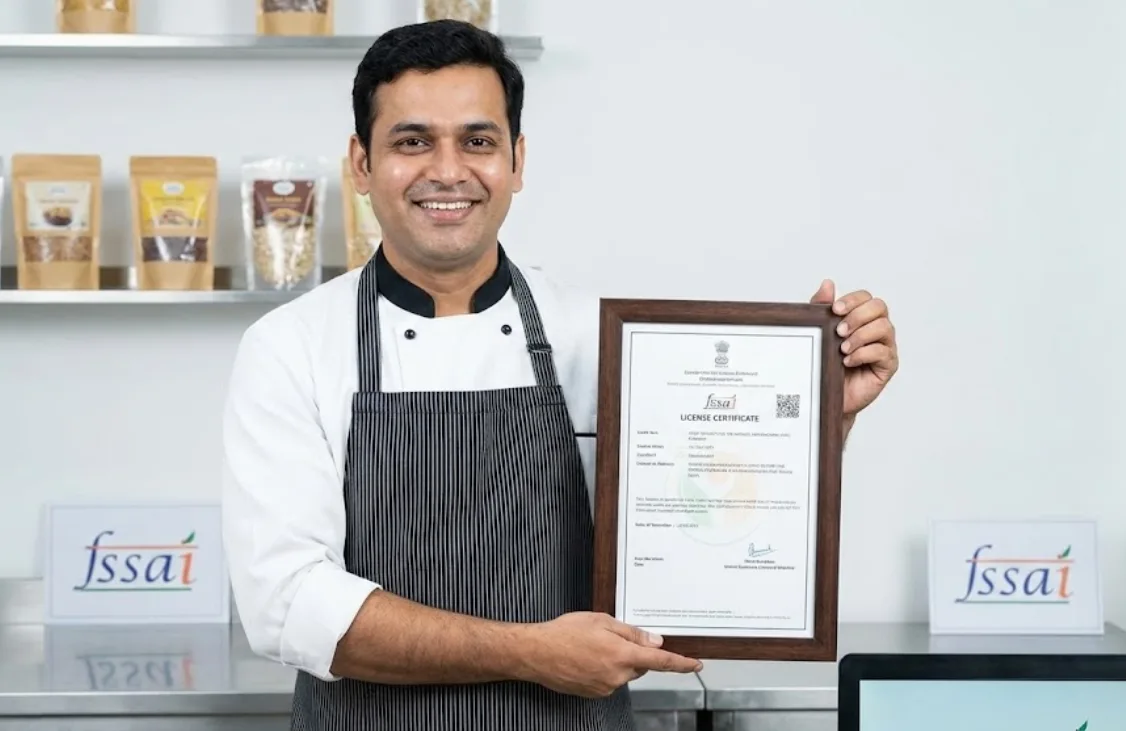
OVERVIEW

Introduction to FSSAI Licence

The Food Safety and Standards Authority of India (FSSAI) is a governmental body responsible for regulating and supervising food safety in India. It is mandatory for all food business operators (FBOs) to obtain an FSSAI license or registration before commencing their business operations.

The 14-digit registration or license number must be printed on all food packages. This license ensures that the food products undergo quality checks, thereby reducing fluid adulteration and substandard products. It promotes public health and builds consumer trust.

REGISTRATION PROCEDURES

FSSAI License Registration Procedures

Complete guide to FSSAI registration procedures for Basic, State, and Central licenses based on your business turnover and requirements.

FSSAI Basic Registration (Form A)

Turnover < ₹12L
Small businesses or startups having annual turnover below Rs.12 lakhs can apply for basic FSSAI Food safety registration. As operations scale up and turnover reaches Rs. 12 lakh bar, the basic registration will need to be upgraded to state license. As the name says it is very basic registration so it won’t be enough for large business firms.

Documents Required for FSSAI Basic Registration

  • 1
    Authorized person address proof
  • 2
    Passport size photo
  • 3
    Business name and address
  • 4
    FSSAI declaration form
  • 5
    Nature of business details
  • FSSAI State License Registration (Form B)

    ₹12L - ₹20Cr
    Businesses having annual turnover between Rs.12 lakhs to 20 crore can apply for FSSAI state license. Food business operators like small to medium-sized manufacturers, storage units, Transporters, Retailers, Restaurants Marketers, distributors etc. are however required to obtain the FSSAI State License Registration.
    FSSAI License is mandatory for anyone who intends to do food business. This not only involves preparing food but everyone who handles food at various stages before it ultimately reaches the customer like raw materials, manufacturing, processing, Restaurants packing and the distribution as well as the agencies who have authority to sell them.

    Documents Required for FSSAI State License

  • 1
    Rental Agreement of Business Premises
  • 2
    ID Proof of the Concerned Person (Aadhaar Card / Driving License / Passport / Voter ID)
  • 3
    If any Government Registration Certificates (Company Incorporation Certificate / Firm Registration / Partnership Deed / Pan card / GST Registration Number / Shop and Establishment Registration / Trade License)
  • 4
    If the applicant is private limited company or partnership firm then they should provide MOA & AOA or Partnership deed copy
  • 5
    For applying State License any One of the following certificate is compulsory (Trade license, Shop & Establishment, Panchayath License, Corporation License, Municipality License)
  • 6
    FSSAI declaration form
  • 7
    Product details in company Letter head
  • FSSAI Central License Registration (Form B)

    > ₹20Cr
    Businesses having annual turnover above 20 crore can apply for FSSAI central license. Eligible food Business Operators like Importers, Manufacturers, operators in central government, Railways, airports, seaports, etc. need to take a Central FSSAI license from Food Standards and Safety Authority of India.

    Documents Required for FSSAI Central License

  • 1
    Rental Agreement of Business Premises
  • 2
    ID Proof of the Concerned Person (Aadhaar Card / Driving License / Passport / Voter ID)
  • 3
    If any Government Registration Certificates (Company Incorporation Certificate / Firm Registration / Partnership Deed / Pan card / GST Registration Number / Shop and Establishment Registration / Trade License)
  • 4
    If the applicant is a private limited company or partnership firm then they should provide MOA & AOA or Partnership deed copy
  • 5
    IE Code (Import Export Code) Certificate (for the category of export and import IE code is compulsory)
  • 6
    Authority letter from the company letterhead to the concerned person stating that he is authorized to file FSSAI application
  • 7
    List of food categories desired to be manufactured (In case of manufacturers)
  • 8
    In case if your business is into mineral water plants then a water test report is compulsory
  • TYPES

    Types of FSSAI Registration

    Based on annual turnover and scale of operations, FSSAI Registration is categorized into three licence types.

    Basic Registration

    For small businesses or startups.
    • Turnover below ₹12 Lakhs
    • Petty retailers
    • Small hawkers
    • Temporary stall holders

    Eligibility: Annual business turnover less than ₹12 Lakhs.

    Validity: 2 Years

    Government Fee: ₹2,211 (Including Govt. fees)

    POPULAR

    State License

    For mid-sized food businesses.

    • Turnover ₹12 Lakhs to ₹20 Crores
    • Manufacturers
    • Transporters
    • Mid-sized restaurants

    Eligibility: Annual turnover between ₹12 Lakhs to ₹20 Crores.

    Validity: 1 Year

    Government Fee: ₹6,991 (Including Govt. fees)

    Central License

    For large businesses & importers/exporters.
    • Turnover above ₹20 Crores
    • Importers / Exporters
    • Multi-state operations
    • Government agencies

    Eligibility: Turnover above ₹20 Crores or business operating across India / e-commerce.

    Validity: 1 Year

    Government Fee: ₹18,600 (Including Govt. fees)

    Benefits of FSSAI Registration

    Why every food business must be registered

    Customer Trust

    Builds strong customer confidence by ensuring supply of safe and non-adulterated food.

    Legal Advantages

    Strengthens legal standing and ensures better regulatory control over food business operations.

    Government Funding & Loans

    Registered businesses get easier access to government funding schemes and loan facilities.

    Use of FSSAI Logo

    Permission to use the FSSAI logo on products increases goodwill and brand trust.

    Brand Value

    FSSAI registration automatically enhances brand credibility in the food industry.

    Business Expansion

    Provides wider scope to expand food business operations across locations.

    Government Recognition

    Recognized by Government of India, resulting in higher consumer confidence.

    Food Business Authorization

    Acts as proof that your food business follows required safety standards.

    Support in Non-Compliance Cases

    Government assistance and structured action in case of future compliance issues.

    Business Growth Boost

    Creates stronger market presence, larger customer base, and faster business growth.

    Documents Required for FSSAI Registration

    All documents below are typically required depending on the licence type (Basic / State / Central). Keep scanned copies ready (PDF/JPG).

    Basic Registration (Form A)

    Turnover < ₹12 lakh
    Basic License is Necessary if the Annual Turnover is less than Rs.12 lakh.
    Documents typically required
    Photo Identity
    Pan card
    NOC by Municipality/Panchayat, Health NOC
    Declaration about Business details in Form A
    Proof of possession of the business premises
    Certificate of Incorporation/ Articles of Association /Partnership deed, etc.

    State License (Form B)

    ₹12 lakh – ₹20 crore
    State License should be obtained when the annual turnover is between 12-20 crores. In case of repacking, relabelling business irrespective of the turnover the business should obtain a State license.
    Documents typically required
    Form-B Duly completed and signed
    Blueprint/layout plan of the processing unit (Manufacturing and processing unit only)
    List of Directors / Partners / Proprietor / Executive Members with contact details and photo ID (Companies only)
    Details of the machinery to use for operations (Manufacturing and processing unit only)
    List of Food categories to be manufactured (Manufacturing unit only)
    Authority letter from the manufacturer in favor of the nominated person with authority
    The analysis report of water to be used in the manufacturing of food items (For Manufacturing and processing units)
    Proof of possession of premises
    Partnership Deed/Affidavit of Proprietorship/MOA /Incorporation
    Copy of certificate obtained under the Coop Act (Co-operatives only)
    NOC & Copy of License from the manufacturer (For relabelers and repackers only)
    Food Safety Management System plan and Recall Plan (If applicable)
    Source of milk and meat (If applicable)
    NOCs from Municipality or local body
    Certificate provided by the Ministry of Tourism (HRACC). (Mandatory for Hotel Only)
    Form IX

    Central License (Form B)

    Turnover > ₹20 crore
    If the annual turnover is above 20 crores then the food business must apply for a Central license.
    Documents typically required
    Form-B Duly completed and signed
    Blueprint/layout plan of the processing unit (Manufacturing and processing unit only)
    List of Directors / Partners / Proprietor / Executive Members with contact details and photo ID (Companies only)
    Details of the machinery to use for operations (Manufacturing and processing unit only)
    List of Food categories to be manufactured (Manufacturing unit only)
    Authority letter from the manufacturer in favor of the nominated person with authority
    The analysis report of water to be used in the manufacturing of food items (For Manufacturing and processing units)
    Proof of possession of premises
    Partnership Deed/Affidavit of Proprietorship/MOA /Incorporation
    Copy of certificate obtained under the Coop Act (Co-operatives only)
    NOC & Copy of License from the manufacturer (For relabelers and repackers only)
    Food Safety Management System plan and Recall Plan (If applicable)
    Source of milk and meat (If applicable)
    NOCs from Municipality or local body
    Certificate provided by the Ministry of Tourism (HRACC). (Mandatory for Hotel Only)
    Declaration Form
    Ministry of Commerce Certificate for 100% EOU
    Supporting documentary proof for turnover
    NOC/PA document issued by FSSAI
    IE CODE document issued by DGFT (For exporters and importers)

    🚀 Apply for FSSAI Online Registration with Expert Assistance

    Accurate Fee & Category Assessment
    End-to-End FSSAI FoSCoS Support
    Faster Processing & Zero Rejection Risks
    Get Expert Assistance Now

    Licence Type & Registration Fees

    FSSAI FoSCos Basic License

    Annual turnover of the business is less than ₹12 Lakhs.
    Validity2 Years

    ₹2211

    Including Govt. fees
    (for 2 years only)
    No Hidden Charges

    FSSAI FoSCos State License

    Annual turnover of the business is between ₹12 Lakhs to ₹20 Crores.
    Validity1 Year

    ₹6991

    Including Govt. fees
    One Time
    No Hidden Charges

    FSSAI FoSCos Central License

    Annual turnover of the business is above ₹20 Crores, or E-commerce business, or businesses operating across all over India.
    Validity1 Year

    ₹18,600

    Including Govt. fees
    One Time
    No Hidden Charges

    FOOD REGISTRATION GUIDE

    Complete Overview of FSSAI Registration

    Detailed information about the authority, legal framework, statutory powers, governance structure, and training initiatives behind food safety regulation in India.

    Foundation

    What is FSSAI?

    The Food Safety and Standards Authority of India (FSSAI) is a governmental body tasked with ensuring food safety in India. It regulates food standards, supervises food business operations, and issues licenses or registrations to food business operators. The FSSAI registration system ensures that food products sold in India adhere to defined safety and quality guidelines. The license number issued is displayed on food products to assure consumers of authenticity and compliance.

    Governance

    Administrative Control

    Government Department

    FSSAI is an autonomous statutory authority operating under the Ministry of Health & Family Welfare, Government of India. It functions as part of the Central Government framework for food safety oversight across India.

    Purpose of Establishment

    FSSAI was created to unify multiple food laws and regulatory bodies into a single efficient system. Earlier food safety regulation was fragmented across departments, causing inconsistency. FSSAI now acts as the single authority responsible for food safety and quality standards nationwide.

    Legal Framework

    Statutory Authority

    Governing Act

    FSSAI was established under the Food Safety & Standards Act, 2006, which provides legal backing for food licensing, regulation, enforcement, and safety compliance across India.

    Statutory Powers

    Frame and notify food safety regulations
    Lay down accreditation guidelines for food testing laboratories
    Provide scientific and technical advice to government bodies
    Develop international food safety standards
    Collect data on food risks, contamination, and consumption patterns
    Promote awareness about food safety and nutrition
    Operations

    Leadership & Structure

    Appointments & Headquarters

    FSSAI is headed by a Chairperson appointed by the Central Government. State-level heads are appointed by the main authority. The headquarters is located in New Delhi, with regional offices across India (Northern, Eastern, North-Eastern, Western, and Southern regions).

    Training & Capacity Building

    FSSAI actively conducts training and awareness programs for food business operators. Initiatives such as FoSTaC help educate food handlers on hygiene, safety practices, and regulatory compliance across India.

    For any food business entering India’s market, obtaining FSSAI Registration is mandatory to operate legally and ensure consumer trust.

    Get Expert Assistance
    FAQ

    Frequently Asked Questions

    Everything you need to know about FSSAI Registration and License.

    Food handlers must clear an annual medical fitness test by a certified medical practitioner. On clearing the medical fitness test they obtain a medical fitness certificate from the practitioner and the local FSSAI representative may record it for the handler to work legally.
    FSSAI is the apex authority that regulates manufacture, sale, storage, distribution and import of food products. Food business operators must obtain FSSAI registration or license by following the FSSAI Act 2006 guidelines and submitting required documents on the FSSAI portal.
    Anyone starting or taking over a food business must register under FSSAI. Licence/registration is required for businesses that prepare, store, distribute or sell food or drink. Once a signed food business registration form is submitted you can start the business.
    The Quality Assurance / Lab Division tests food products and related data. Its outputs support enforcement, law updates, guideline creation and accreditation. Labs may be FSSAI-owned or accredited third-party labs depending on requirements.
    The HR Division manages staffing and human resources tasks for FSSAI — hiring, payroll and related administrative functions — and does not directly handle food safety regulation.
    The Standards Division creates and maintains food safety standards used across testing, regulation and enforcement. It defines benchmarks for ingredients, preparation, packaging and storage so regulators and labs can evaluate compliance.
    FSSAI conducts research to evaluate and improve testing methods, create new standards and ensure regulatory frameworks match the latest science. This includes reviewing existing methodologies and developing new evaluation standards when required.
    Quality assurance covers ingredients, manufacturing, packaging, storage and import controls. Labs are accredited and quality checks ensure food products meet safety standards. Current accredited lab counts include NABL-notified labs, state labs and referral labs.
    Yes — FSSAI sets numerous standards across ingredients, manufacturing processes, packaging and storage. These product standards form the backbone of regulatory enforcement and lab testing.
    Yes. Any business involved at any stage of the food supply chain must obtain a valid FSSAI license or registration before operating. The certificate is issued via the FSSAI portal.
    Common documents include photo ID of the food business operator, supporting IDs (Aadhaar, PAN, passport, voter ID, etc.) and supporting documents like NOC from municipality/panchayat or health NOC, along with business proof depending on license type.
    Penalties vary under the Food Safety & Standards Act; violations can attract fines (for example up to one lakh rupees in certain sections). Specific penalties depend on the offence and applicable sections of the Act.
    Currently FSSAI has no dedicated separate regulations specifically for GM foods; regulation may fall under other agencies. Organic foods are governed by separate organic standards; FSSAI doesn’t yet have separate organic product regulations in the same way.
    FSSAI issues microbiological standards and guidance relevant to food safety; check the FSSAI portal for specific microbiological limits and testing guidance published by the authority.
    India has a large network of labs (government and private) accredited for food testing under FSSAI oversight. Details of accredited labs (NABL notified, state labs, referral labs) are available on the FSSAI website.
    Yes. FSSAI uses a mix of its own labs and accredited private labs for testing. Accredited third-party labs form part of the larger network under FSSAI accreditation programs.
    Consumers benefit from higher food quality and safety, better health standards, reliable information about food, a regulatory framework for businesses, and mechanisms to seek compensation in case of harm from unsafe food.
    An FSSAI licence can be obtained for 1 to 5 years. Fees vary with chosen duration. Renew before expiry to avoid penalties — renewal should be completed before the license end date.
    Scroll to Top