Companies Act, 2013 Compliant

Build a
Non-Profit with Impact.

Get your Section 8 Company Meaning registered as a Section 8 Company with India’s most trusted legal partner. We manage incorporation, compliance, and approvals so you can focus on your social mission.

+35k
Trusted by 35,000+ Businesses

Start Section 8 Company Meaning

Fill in the form and complete process to receive your certificate.

Contact Form Demo

Note: We are India’s fastest growing online business services platform dedicated to helping people to start and grow their business, at an affordable cost. Our aim is to help the entrepreneur with regulatory requirements, and offering support at every stage to ensure the business remains compliant and continually growing. We are Private Organization and providing services and assistance for Business Benefits who require consultation.

What is a Section 8 Company?

A Section 8 Company is a legally recognized non-profit entity formed under the Companies Act, 2013 to promote charitable, educational, social, religious, and environmental objectives.

Unlike private or public limited companies, a Section 8 Company cannot distribute profits among its members. Any income or surplus generated must be reinvested to further its social objectives. This structure offers high credibility, limited liability protection, tax exemptions, and eligibility for government grants, CSR funding, and international collaborations—making it a preferred choice for NGOs, trusts, and social enterprises.

Understanding Section 8 Companies

Section 8 Companies operate with a corporate governance structure while maintaining a strong charitable focus. Governed by the Ministry of Corporate Affairs (MCA) and registered with the Registrar of Companies (ROC), they ensure transparency, accountability, and long-term sustainability.

These entities can receive CSR funding, claim tax exemptions under Sections 12A & 80G, and apply for FCRA approval to accept foreign contributions—making them the most structured and trusted non-profit model in India.


Legal Framework & Governing Authorities

Ministry of Corporate Affairs (MCA)

Approves incorporation and issues the license to operate as a Section 8 Company.

Registrar of Companies (ROC)

Handles registration, compliance filings, and governance oversight.

Income Tax Department

Grants tax exemptions under Sections 12A & 80G for companies and donors.

FCRA Authority

Regulates eligibility to receive foreign donations and international grants.

NITI Aayog & Govt Bodies

Facilitate government funding, welfare projects, and policy support.

Registering as a Section 8 Company provides unmatched credibility, structured governance, and financial advantages—helping organizations scale their social impact with transparency and trust.

Key Benefits Section 8 Company

Why a Section 8 Company is the preferred choice for NGOs, trusts and social enterprises.

Tax Exemptions & Financial Benefits

Registering as a Section 8 entity enables donors to claim rebates (Section 80G) and allows the company to apply for 12A/80G registrations for long-term tax relief.

Credibility & Legal Recognition

A Section 8 Company carries high legal credibility—boosting donor trust, enabling CSR partnerships and easing access to grants and institutional funding.

Limited Liability Protection

Directors and members enjoy limited liability—personal assets are generally protected from company debts and legal exposure.

Eligibility for Grants & Schemes

Section 8 status increases eligibility for government schemes, grants, CSR funding and institutional partnerships—opening new funding channels.

Better Compliance & Governance

A structured corporate framework promotes transparency, stronger governance and audit-readiness—helping with donor confidence and legal compliance.

No Minimum Capital Requirement

There is no statutory minimum paid-up capital—making Section 8 registration accessible to grassroots initiatives and small organisations.

Eligibility Criteria for Section 8 Company Registration

Understand who can register a Section 8 Company and the permitted non‑profit activities under the Companies Act, 2013.

1

Eligibility Conditions

A Section 8 Company is designed exclusively for organizations working towards charitable and social objectives. The key eligibility requirements include:
  • Formed for charitable, educational, religious, scientific, or social welfare purposes
  • Profits must be reinvested into organizational objectives
  • Minimum 2 directors (Private) or 3 directors (Public)
  • At least one director must be an Indian resident
  • Name must include Foundation, Association, Society, Council, or Institute
  • 2

    Who Can Register a Section 8 Company?

    Section 8 Companies can be formed by individuals, organizations, corporates, and even foreign entities subject to compliance.
    Individuals & Groups

    Any person or group with a social objective

    NGOs & Trusts

    Existing NGOs can convert for better credibility

    Corporate Entities

    CSR-driven organizations managing social initiatives

    Foreign Nationals

    Allowed with FCRA compliance

    3

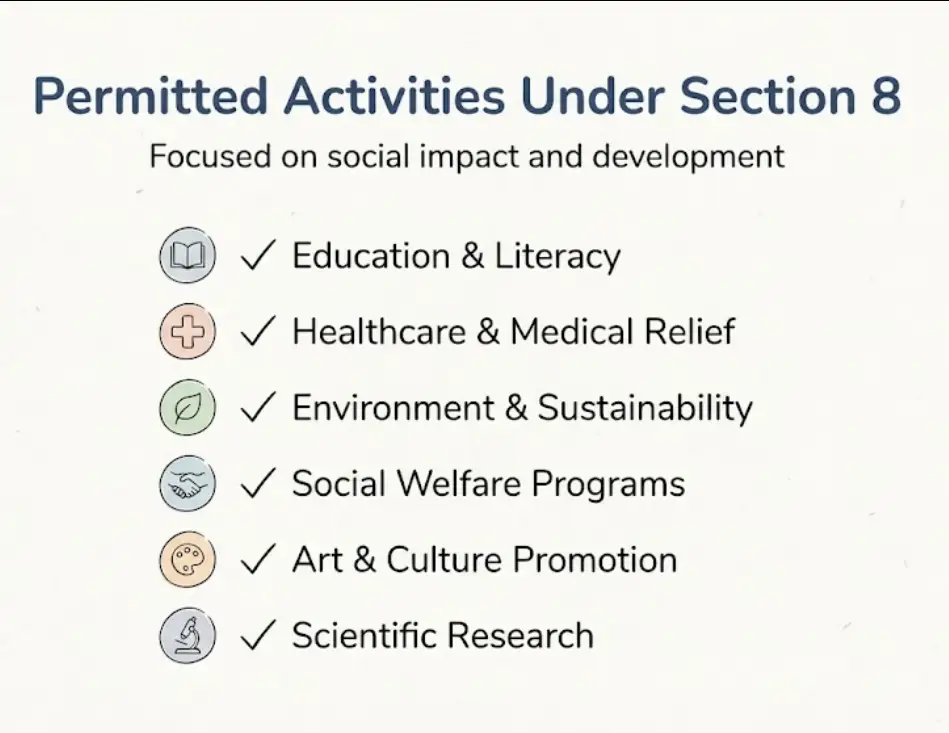
    Permitted Activities Under Section 8

    Section 8 Companies can undertake a wide range of non‑profit activities focused on social impact and development.
    📘 Education & Literacy
    🏥 Healthcare & Medical Relief
    🌱 Environment & Sustainability
    🤝 Social Welfare Programs
    🎨 Art & Culture Promotion
    🔬 Scientific Research

    Need help registering your Section 8 Company quickly?

    Get a free eligibility review and a tailored fee estimate from our non-profit registration specialists. We handle documentation, ROC filing, and follow-up — so you get your Section 8 Company registered without delays.

    Documents Required for Section 8 Company

    Prepare these documents for smooth Section 8 Company registration

    PAN Card

    PAN of all directors & shareholders

    Identity Proof

    Aadhaar / Passport / Voter ID

    Address Proof

    Utility bill / Bank statement

    Passport

    For foreign nationals (apostilled)

    Registered Office Proof

    Electricity / Water / Property tax bill

    Rental Agreement

    If office premises are rented

    NOC

    From property owner

    MOA & AOA

    Company objectives & rules

    INC-14 & INC-15

    Declarations for Section 8

    DIN & DSC

    Director identification & signature

    Projected Income

    3-year financial projection

    Promoter Details

    Members & promoters information

    Additional Documents (If Applicable)

    Based on nature of activities

    Resolution

    From existing entity (if any)

    Government Approval

    If activities are regulated

    STEP-BY-STEP

    Process for Section 8 Company Registration

    A legally compliant process to register a non-profit Section 8 Company in India

    1

    Obtain Digital Signature Certificate (DSC)

    All proposed directors must obtain DSCs to digitally sign incorporation and licensing documents.

    2

    Apply for Director Identification Number (DIN)

    Directors must obtain DIN through DIR-3 or during SPICe+ filing as part of incorporation.

    3

    Reserve Company Name (RUN)

    Once approved, the proposed name is reserved for a limited validity period (typically 20 days), within which incorporation filings must be completed.

    4

    Draft MoA & AoA

    Prepare Memorandum and Articles defining charitable objectives, governance structure, and internal rules. The Memorandum of Association must clearly declare the non-profit objectives of the company and restrict the distribution of profits to members.

    5

    File INC-12 for Section 8 License

    Apply for Section 8 license by submitting INC-12 with MoA, AoA, declarations, and supporting documents.

    6

    File SPICe+ for Incorporation

    Submit SPICe+ along with AGILE-PRO, INC-9, MoA, and AoA for company incorporation.

    7

    Receive COI & Section 8 License

    MCA issues Certificate of Incorporation, PAN, TAN, and Section 8 license upon approval.

    8

    Open Bank Account & Start Operations

    Open a company bank account and commence charitable activities in line with Section 8 objectives.

    Annual Compliance & Tax Exemptions

    File MGT-7 & AOC-4 annually and apply for 12A & 80G registrations to claim tax exemptions.

    Section 8 Company Fees & Processing Time

    Transparent cost structure and realistic timelines

    Government Fees & Other Charges

    Section 8 Companies enjoy reduced government fees compared to other company structures.
    Key cost components include:
    DSC (Digital Signature Certificate): ₹1,000 – ₹2,000 per director
    DIN (Director Identification Number): ₹500 per director (if not via SPICe+)
    Name Reservation (RUN): ₹1,000
    INC-12 Filing Fee: ₹2,000 – ₹5,000 (state dependent)
    Stamp Duty: As per state regulations
    Professional Fees: ₹10,000 – ₹25,000 (approx.)

    Expected Processing Time & Approval Duration

    The complete Section 8 registration process usually takes 20–30 working days.
    Estimated timeline breakdown:
    DSC & DIN: 1–3 days
    Name Approval (RUN): 2–5 days
    INC-12 License Approval: 10–15 days
    Incorporation Certificate: 7–10 days after approval
    Timelines may vary due to document corrections, name rejection, or MCA workload.

    Post‑Registration Compliance & Legal Obligations

    Key compliances every Section 8 Company must follow after registration

    Maintaining Financial Records & Annual Filing

    Section 8 companies must maintain proper books of accounts and file annual compliances under the Companies Act, 2013.
    • Form AOC‑4: Filing of financial statements
    • Form MGT‑7: Annual return with MCA
    • Audit: Mandatory audit by Chartered Accountant

    Income Tax & GST Compliance

    Section 8 Companies must comply with tax laws depending on their activities.
    • 12A & 80G: Tax exemption registration
    • GST: Mandatory if turnover exceeds prescribed limits
    • TDS: Applicable on payments made

    Fundraising & Grant Regulations

    Section 8 Companies can raise funds, but strict compliance is mandatory.
    • FCRA: Mandatory for foreign donations
    • CSR: Compliance with Companies Act
    • Utilisation: Proper fund tracking & documentation

    Common Challenges in Section 8 Company Registration

    Key issues faced during registration and practical solutions to overcome them

    Documentation Errors & Delays

    Solution: Ensure that MOA, AOA, declarations, and identity proofs are accurately prepared and reviewed by professionals before submission to avoid rejections.

    ROC & MCA Compliance Issues

    Solution: Maintain proper records, file annual returns on time, and follow MCA guidelines regularly to prevent penalties and legal complications.

    Misinterpretation of Non‑Profit Activities

    Solution: Clearly define charitable objectives in the MOA and ensure that all funds are strictly used for social purposes to remain compliant.

    Why Choose Charteredzone
    for Section 8 Company Registration?

    Trusted expertise, transparent pricing, and complete compliance support to help you focus on your social mission.

    01

    Expert Guidance & Hassle‑Free Registration

    Our experienced professionals manage documentation, approvals, and filings end‑to‑end, ensuring a smooth and error‑free Section 8 company registration.

    02

    Complete Compliance & Legal Support

    From ROC & MCA compliance to post‑registration obligations, we help your Section 8 company remain legally compliant and audit‑ready at all times.

    03

    Affordable, Transparent & Reliable

    We offer cost‑effective packages with no hidden charges and dedicated support—giving you clarity, confidence, and peace of mind.

    Frequently Asked Questions

    A Section 8 Company is a non-profit organization registered under the Companies Act, 2013, formed to promote charitable activities such as education, social welfare, arts, science, or environmental protection. Its profits are reinvested to achieve its objectives and are not distributed as dividends.
    Any individual or group of individuals, including NGOs, trusts, and societies, can register a Section 8 Company provided the objective is charitable. Foreign nationals may register subject to necessary approvals.
    Section 8 Companies enjoy tax exemptions, limited liability protection, higher legal credibility, eligibility for government grants, CSR funding, and increased donor confidence.
    The company must have a non-profit objective, comply with the Companies Act, 2013, reinvest profits into its mission, and must not distribute dividends to its members.
    Documents include PAN and Aadhaar of directors, address proof, DSC, DIN, company name approval, Memorandum of Association (MOA), Articles of Association (AOA), and projected financial statements.
    Registration costs depend on government fees and professional charges. On average, the cost ranges between ₹5,000 and ₹15,000 depending on services and location.
    The registration process usually takes 25 to 40 days, including name approval, document verification, MOA and AOA approval, and issuance of the Certificate of Incorporation.
    Yes, Section 8 Companies can raise funds through grants, CSR contributions, and foreign donations with FCRA approval, and may also generate revenue through permitted activities.
    Yes, conversion is allowed with prior approval from the Regional Director of the Ministry of Corporate Affairs (MCA) and necessary amendments to MOA and AOA.
    Annual compliances include filing financial statements, income tax returns, conducting board meetings, maintaining statutory records, and complying with ROC and MCA regulations.
    GST registration is required if the company provides taxable goods or services and crosses the GST threshold. Donations and grants alone generally do not attract GST.
    Yes, directors can receive reasonable remuneration for professional services rendered, but profits cannot be distributed as dividends.
    Non-compliance may result in penalties, fines, cancellation of registration, and legal action against directors for violation of MCA or income tax laws.
    Yes, foreign nationals and NRIs can register a Section 8 Company, but FCRA approval is required to receive foreign donations.
    Charteredzone provides expert guidance, complete documentation, affordable pricing, and end-to-end compliance support to ensure smooth and timely registration.
    Scroll to Top